| Where
to get the rest of the information:
When
designing the heating element, you probably know the power
and the voltage you want to operate the heater at.
Knowing
the Power desired (watts) and the Voltage that is available
the current can be calculated from Formula F2. By plugging
this current into Formula F1, you can determine the resistance
required. As long as the heating element matches that resistance,
electrically you are OK. The life of the element, will be
determined by other characteristics such as environment, (meaning
temperature and chemical make up), and surface loading. Occasionally
you cannot get the all of the characteristics into an acceptable
range and you will have to re-visit the electrical design,
possibly using a lower voltage or other means to get a reasonable
life expectancy.
The
above formula provides a method of determining the resistance
of the heating element. Once this is known, the size and length
of the heating element must be determined. Generally this
is an iterative process where one wire or strip size is chosen,
then the length is calculated, and finally the physical size
is checked to see if it will fit in the space available. Then,
if needed, the size is increased or decreased to lengthen
or shorten the element and the design is again rechecked.
The
resistance per unit length of a given cross section can be
calculated or looked it up in a table provided by manufacturers
of resistance materials. If you choose to calculate it, it
can be calculated by knowing the resistivity of the material.
With
the resistivity of a material, one can calculate the resistance
per unit length for any cross section. Resistivity technically
is in units of "Ohm-length", results in "Ohm-foot" for English
units and or "Ohm-meter" for Metric. This is actually a reduction
units from the formula that is somewhat easier to understand:

Where R is the Resisitivity and
L is the unit of length.
As
you can see this expression can be reduced to Ohm-Length,
but is not as user friendly.
In
the English System, (inches and feet)
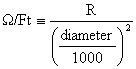
For round wire:
Resistivity has the units of Ohms/circular-mil-foot.
To calculate the resistance per foot, the resistivity is divided
by the diameter (expressed in mills) squared.
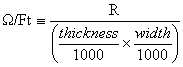
For a rectangular section,
Resistivity has the units of Ohms/square-mil-foot.
To calculate the resistance per foot, the resistivity is divided
by the width (expressed in mills) times the thickness (expressed
in mills).
The
difference between the rectangular and circular Resistivity
is the factor of pi
divided by 4 .
For
dimensions in metric units:
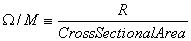
For round and rectangular cross sections:
Resistivity has the units of ohms-mm^2/m.
To calculate the resistance
per m, the resistivity is divided by the cross sectional area
in mm.
The
key design criteria for determining the life of an element
is the temperature that the element operates at. Unfortunately
there is no easy way to determine what that temperature will
be. A set of guidelines for element configurations combined
with a set of allowable watt loading are best used to review
the design and if the life will be acceptable.
The
watt loading of an element is the amount of energy being transmitted
through a unit of surface area. The greater the amount of
energy to be transferred per unit surface area, the hotter
the element must run in order to transmit the energy to the
objects receiving the energy.
The
easiest way to understand this is to consider an element in
open air. In order to get it to glow red it has to be loaded
very heavy, transmitting a large amount of energy. If you
now place the same element in a furnace at 1800F / 1000C,
the element will glow (with the same intensity as the rest
of the furnace) without and power being applied to the element.
As you now increase the power the element is generating, the
element will be at a temperature above 1800F / 1000C. If you
would place the same load on the element that was required
to heat it to a glowing red in at room temperature, it would
overheat and fail very quickly.
If
the surface loading on the element is too high, you should
increase the length. Increasing the size of the cross section
can do this.
The
surface of the heating element is calculated by calculating
the perimeter of the heater, multiplied by its length
For
more information on the surface loading for elements click
on this link:
Surface
Loading for Heating Elementst
|


